
domingo, 10 de abril de 2016
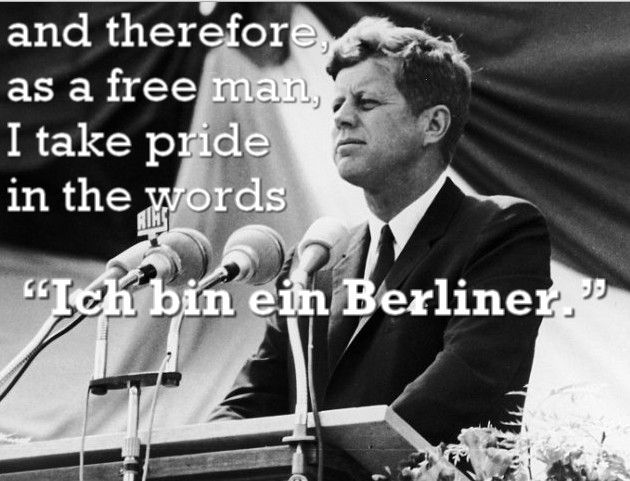
Ich Bein Ein Berliner
The 26th June 1963, in Western Berlin, the president John Fitzgerald Kennedy pronounced his famous quote in front of thousands of citizens from Germany, 'I am a Berliner'. The reason for his appearance and speech was the 15th anniversary of the Berlin Blockade exacted by the Soviet Union, and that had led into the construction of the Berlin Wall. Kennedy spoke to give hope to all those men and women. In his speech, he did not only said how if anyone had doubts about the communist system , they could come and see Berlin, and the consequences of that system, but also talked about men's freedom, and how until everyone was free, all of us would be Berliners, giving our support to all those Berliners that were suffering the consequences of the Wall. By doing this, J.F. Kennedy gave hope to the citizens that needed it, and he promised that all the world wouldn't have freedom until they received it. In simple words, he gave the people the solidarity they desperately needed due to their situation. In my opinion, it was a really brave and heart touching speech, that encouraged those citizens to never give up and resist, because they were not alone, they had all the support they could ever require. Because at the end, we were all like them. We were all Berliners.

domingo, 3 de abril de 2016
Schindler's List: The Harsh Reality

Considered to be one of the greatest movie adaptations of all time, not only because of its truthfulness, but its splendor, Schindler's List is the masterpiece feature film that tells us the history of Oskar Schindler, the German entrepreneur, born in Austria Hungary that saved the life of 1200 known Jews during the 2nd World War, when concealing them in his factory as workers, and making them stay alive. The movie experiences not only his history and redemption path, from being a selfish and narcissistic man into becoming a kind and courteous person; but also how harsh was that moment for the Jewish Community, and how they suffered so many things. The story, directed and written by the well known director Steven Spielberg and the screenwriter Steven Zaillian , owns an outstanding cast, formed by Liam Neeson in the role of Oskar Schindler, Ralph Fiennes performing the Nazi Officer, Amon Goeth, and Sir Ben Kingsley in the role of Itzhak Stern, the Jew accountant that helped Mr. Schindler. The only way to describe the main sensation gained with the display of the movie is heart breaking. It makes you feel how horrific it was, and it makes you cry, though in a special way, not as a regular movie. Because you know that everything that you are watching happened, and there is no way back for that. Millions of innocents passed away, and that won't change. The story ends itself as a tribute to all this people, the fallen that shouldn't have fallen. It is remarkable the Black and White Color Style used in all the scenes, that plays with perspectives and shadows, making us feel very differently depending on how the light effect is applied. All with the exception of the Girl with the Red Coat, that in my opinion represents how innocent children are, doesn't matter with race do they belong to, or in which situation they are in. Schindler understands this, and he sees how cruel and inhumane is what he is witnessing. None country wins anything, or any race. The War takes it all. In short, it is the greatest film that features the effects of the Holocaust, and shows how even when there was hope for many, many others didn't have that chance. So is it a sad or hopeful movie? None of them. It is a real one. The tints do not only exist in the pictures, but in history, and in our world. That is what Schindler's List is. Reality. The harsh reality.

lunes, 22 de febrero de 2016
domingo, 21 de febrero de 2016
The Changing Role of Women in the 1920s
1.Why did the role of (some) women change in the twenties?
Because since World War I, women had got used to work as men, and in the 1920s they felt that they were not just house workers for longer.
2. Analyze the following advertisement:
A-It's an advertisement that encourages women and girls to struggle to work and live as guys, telling them that they should act independently, and work and earn as much money as them, in this case, as graphic designers.
B- I quite agree with it. I think that it is a positive message for that times, though in muy opinion it should be beyond that. It's not that "even" they can earn as much as men, is should be that they must earn the same for the same jobs. So I think it's good, though it could be much better nowadays for example.
C-I do, as well as I think that not only women should support women, or men support men, but everyone should support everyone else, leaving the genre apart.
3. Are you ready to walk in someone else's shoes? Imagine what it was like to be a flapper in the Roaring Twenties. Choose a name, age, civil status, city, economic class, job... and describe your daily routine on a Friday:
My name is Audrey, and I'm 29 years old. I'm not married, though I'm dating the gorgeous Jack Wilder, the director of the main advertisement company in Los Angeles. Lucky me! Today is my favorite day of the week, because after work I always meet Lilly and Emmanuelle to go shopping. I work as a secretary in a publicity magazine, it's incredible how many people I meet everyday! After our visit to the shops, I'll go to have a little meal with Jack, though not too long, he is really busy today. At about 9 pm, I will go to "La Rose", which is the trending bar at Los Angeles. I will go with 6 of my friends, Lilly, Victoria, Sarah, Coco, Louise and Clara, and we will have real fun! Today is Double M's Night, Martini and Marlboro. My day couldn't be better!

Because since World War I, women had got used to work as men, and in the 1920s they felt that they were not just house workers for longer.
2. Analyze the following advertisement:
A-It's an advertisement that encourages women and girls to struggle to work and live as guys, telling them that they should act independently, and work and earn as much money as them, in this case, as graphic designers.
B- I quite agree with it. I think that it is a positive message for that times, though in muy opinion it should be beyond that. It's not that "even" they can earn as much as men, is should be that they must earn the same for the same jobs. So I think it's good, though it could be much better nowadays for example.
C-I do, as well as I think that not only women should support women, or men support men, but everyone should support everyone else, leaving the genre apart.
3. Are you ready to walk in someone else's shoes? Imagine what it was like to be a flapper in the Roaring Twenties. Choose a name, age, civil status, city, economic class, job... and describe your daily routine on a Friday:
My name is Audrey, and I'm 29 years old. I'm not married, though I'm dating the gorgeous Jack Wilder, the director of the main advertisement company in Los Angeles. Lucky me! Today is my favorite day of the week, because after work I always meet Lilly and Emmanuelle to go shopping. I work as a secretary in a publicity magazine, it's incredible how many people I meet everyday! After our visit to the shops, I'll go to have a little meal with Jack, though not too long, he is really busy today. At about 9 pm, I will go to "La Rose", which is the trending bar at Los Angeles. I will go with 6 of my friends, Lilly, Victoria, Sarah, Coco, Louise and Clara, and we will have real fun! Today is Double M's Night, Martini and Marlboro. My day couldn't be better!

The Hoovervilles
1.What were they?
They were settlements of people that had lost their homes due to the Great Depression, that were built by them in isolated and empty lands, and they constructed tents and shanties. The authorities usually didn't interact with them due to the needs of the population.
2.Who were they named after? Why?
They were named after Herbert Hoover, who was the president of the USA at those times. People named Hoovervilles after him because he was blamed to have left the country fall in the Great Depression and for the share exchange problems.
3.In "The Grapes of Wrath", the Joad family stayed in a Hooverville. Who wrote the novel?
It was written by the american novelist John Steinbeck, author of one of my favourite novels of all time, "Of Mice and Men".

They were settlements of people that had lost their homes due to the Great Depression, that were built by them in isolated and empty lands, and they constructed tents and shanties. The authorities usually didn't interact with them due to the needs of the population.
2.Who were they named after? Why?
They were named after Herbert Hoover, who was the president of the USA at those times. People named Hoovervilles after him because he was blamed to have left the country fall in the Great Depression and for the share exchange problems.
3.In "The Grapes of Wrath", the Joad family stayed in a Hooverville. Who wrote the novel?
It was written by the american novelist John Steinbeck, author of one of my favourite novels of all time, "Of Mice and Men".

The Story of Al Capone
Alphonse Gabriel Capone was born in Brooklyn, New York, in 1889. Son of italian parents, Al had a rough childhood, due to the the poorness that his family suffered. When he was just 14, he left school, and started working in different little businesses, until he met the gangster Johnny Torrio, who became his mentor. He got the nickname "Scarface" after a bar fight ended up with a razor cutting trough his face and neck. After gaining fame and power, he moved to Chicago, where he became the main gangster since 1924, taking after alcohol, gambling and prostitution activities. Due to the Prohibition, he became one of the main public enemies in the state. The 14th February 1929 he murdered all along with his henchmen the other 5 main gangs leaders, in what was called "The Bloody Valentine's Day". After years, an agent from The United States Department of Treasury, Elliot Ness, decided to stand against corruption and fight for law. He got enough evidences to make Capone go to jail, specially from gambling and tax evasion. He was first sent to the Atlanta Prison, and then to the Alcatraz Island in 1934, when his empire fell down.


sábado, 2 de enero de 2016
Marie Antoinette, the Analysis:
 1. Plot:
The movie tells the story of the young Marie Antoinette, the
heir of Austria, that is engaged with the future king of France, the
young Louis XVI. We will see how she has to get used to her
new life, as well as how her marriage doesn't get consummated, all as
the fault of the dauphin, that doesn't show any interest about her. A
lot of time will pass, and even a romance with the Count Hans Axel
von Fersen, until she gets the interest she wants. Unfortunately, the
Revolution is about to come, to change the history of France, and her
life, forever.
2. Why did she get married?;
Marie Antoinette had an arranged marriage with Louis XVI to insurance the political and demographic relation between Austria and France, that had been enemies for a long time. This union was ment to renew that relation, and make a better future for both of them.3. Settings and their meanings:
The story mainly takes place in Paris, in different forests and backgrounds, but more specifically, mainly in the Palace of the King. All the settings tend to be huge, full of space and luxury, and usually overloaded. They make her look small, like an ant in an enormous ocean, at least from my point of view. She also starts to get accostumed to all those luxuries, and she becomes kind of posh, and addicted to overcosts. She spends a lot of money to maintain all those luxuries, and even to increase them.4. The Marriage:
The marriage was a perfect example of a engaged marriage at first, where there was almost no interest or attraction between the couple, specially coming from the king, that almost ignored her desires to consummate it, and she felt that it was her fault. By the end of the movie, they both start to like each other more, and to accept themselves as a couple, consummating the marriage several times .5. Louis XV and his family:
It was a rich and powerful family, obsessed with luxuries and traditions. They even made Marie disconnect herself from any possible link to her life as the archduchess of Austria. They were all used to their lives as important and luxurious people, and they all enjoyed that. The king even had the company of a official mistress, and he moved with her with no shame or guilt about that, fact that surprises Marie Antoinette.6. Why it was important to have a heir?
The importance of having a heir was vital, because if not, there was no insurance between Marie and Louis, and also the terms of the relation between France and Austria could easily change. It was fundamental to have a baby.7. Habits, relations, lifestyles:
The lifestyle was, as I have already said, luxurious and extravagant. People tended to spend a lot of money, and to waste a lot of food, clothing and money itself too. There were usually cold and false relationships between the families, full with gossip and false respect. There were many protocols, some of them really ridiculous established, and the were sacred. In my opinion, it was an extremely extravagant and stupid lifestyle, and in part, those examples led to a revolution of the people against the loyalty.8.The Mistress:
She was a young woman compared to him,
and her job was to satisfie the king in a sexual way. Due to this,
the king gave her a title, as well as many luxuries and power, just
like if she was from the nobility too. She really influenced him,
because he wanted her to remain happy and motivated. Due to this,
almost everyone disliked her, specially the other women, including
Marie Antoinette, that thought that she was a “high class whore”,
and that didn't deserve the power and rights she had.
9.Daily Routine:
The days and routines were always the same for Marie. She woke up in a ridiculous protocol, that involved everyone staring at her, and many reverences. She spent the day doing the same and exact things, which were bassicly trying on clothes and hairstyles, playing with her dogs, spending time with her friends, eating and drinking tea... In my opinion that lifestyle was kind of dull and boring, but she got accostumed to it, more or less, of course.10. Food, clothing, alcohol:
The food, the clothes and the alcohol have an important role. They are the main entertainment of the nobility, and they are always extravagant and a complete waste of money. They eat, drink a buy a lot, while the rest of the people in the country suffers from hunger and die.11. Entertainment:
The main ways of entertainment for the wealthy families were specially hunting, doing picnics outside, buying clothes, going to parties, drinking and eating a lot, and playing different games and gambling.12. Mary Teresa:
Mary Teresa the 1st was the mother of Marie Antoinette, and her main worry was that her daughter was giving signals of sexual interest or pregnancy. Instead of listening to the truth, she blamed Marie for not being attractive, and not awaking the sexual interest of the king. She made her feel guilty and blamed for something that wasn't her fault.13. France's opinion:
They thought she was a posh woman, that only wanted wealthiness and power, and that thought that she was better that the king, and the french people in general. They also knew that she spent a lot of money, and that she didn't gave birth to a heir, so they blamed her for being doing that on purpose, to dare the king.14. A good queen?
In my opinion, Marie Antoinette was not a good king. She didn't show interest in any of the problems of the country, at least, according to what is shown in the movie. She only cared about her clothes, her hobbies, and her desires. I think that the nobility deserved to be distroned, and expelled, but I would NEVER think that anyone could deserve the ending she had. At the end of the movie she tries to escape to Varennes, and the movie ends there. The real story tells that they were caught in Varennes, brought back, and murdered and decapitated. I think no one would ever deserve that ending, it doesn't matter which person are we talking about.15. Reasons of the Revolution:
From the film one can easily see that the main reason that impulsed the people doing what they did was the general poorness and how the nobility wasted and throwed money away, while the people were starving and sick. The people decided to stop the situation, and get rid of the nobility. I don't think they did it in a correct way when killing almost every noble, though i have to admit, it would be difficult to blame their ideals.
Suscribirse a:
Entradas (Atom)